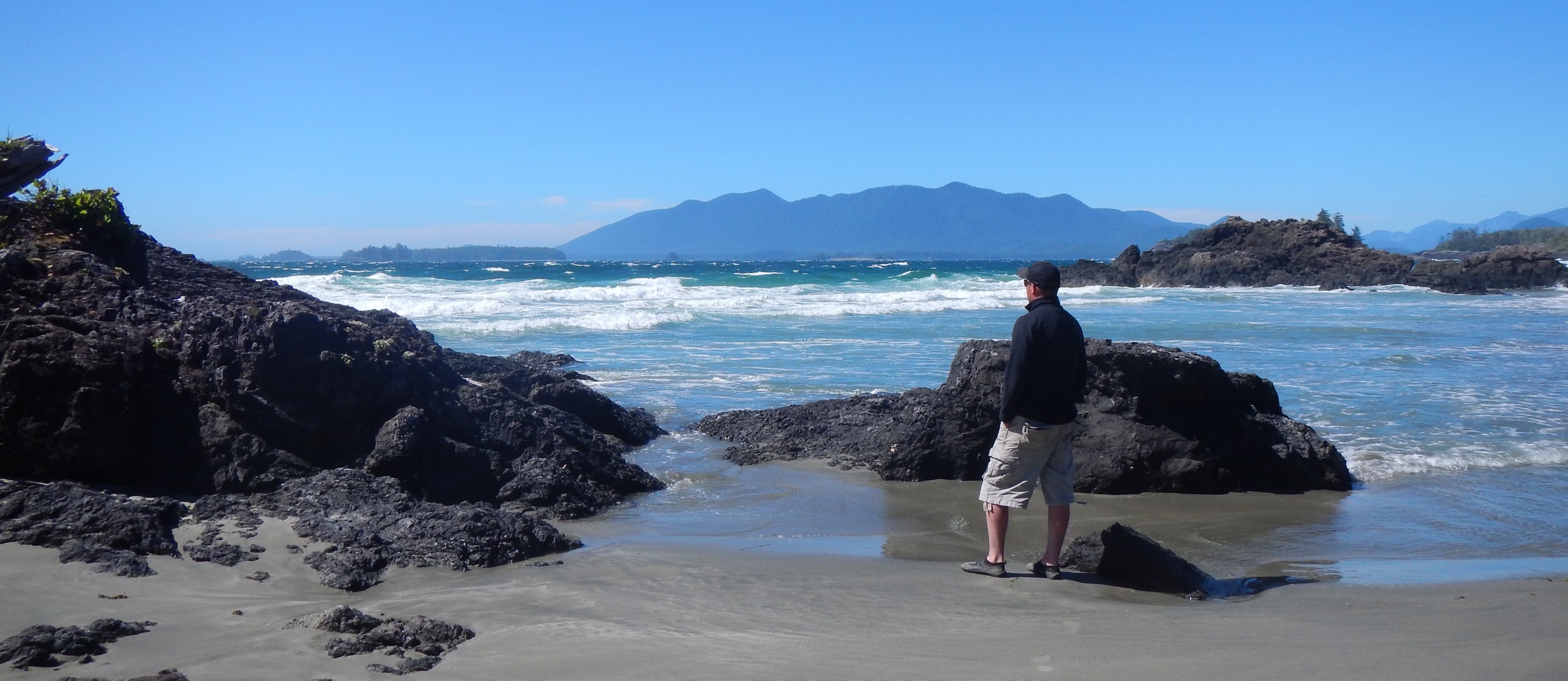
…the last time I entered the territory of the Ka:’yu:’k’t’h’ / Che:k:tles7et’h’ First Nation in 2013, my kayak was swept away below the high tide line which left me stranded for 3 days on Spring Island. The land and sea is formidable, mysterious and absolute. My images created in the territory during this time lead to publications in BC Magazine and National Geographic Traveler U.K. You get what you give and you take what is given. Today, I am looking forward to seeing what’s next as I put foot to ground and paddle to water in this magical place.


This weekend, I will be joining forces with Documentary Filmmaker Paul Novy from Iceberg Films icebergfilms.com to discuss the relationships between nature and photography and to showcase the west coast of Vancouver Island at it’s finest. We’ll be venturing out to Rugged Point env.gov.bc.ca/…/explore/parkpgs/rugged_pt by kayak and spending 3-4 days immersing ourselves in our surroundings, photographing and filming seascapes and possibly even the wolf, bear and cougar that are known to frequent this area. This will be the first of many projects that we have planned.
Thank you to the BC Marine Trails Network bcmarinetrails.org for being the foremost resource regarding coastal BC access by kayak, canoe, and other non-motorized small boats.

Thank you to the Ka:’yu:’k’t’h’/Chek’tles7et’h’ First Nations for allowing us to enter your traditional territory maanulth.ca/about_fn_kyuquot_checlesaht.asp

Thank you in advance for the hospitality offered by Fair Harbour Marina and Campground gatewaytokyuquot.com/fairharbour

Talk about being in the right place at the right time, this is only about a 10 minute drive from my place on Vancouver Island. I have yet to actually see an orca for myself, surprising I know. A reminder to everyone to respect marine wildlife viewing practices. In this case it seems that the pod approached the kayaks. Still, it would be advisable to vacate the area in this kind of situation.
Ken Heinrich and his daughters had an amazing close encounter experience with a pod of orcas Saturday evening off of Gartley Beach.
“A group of orcas were in the area and while out on our kayaks they moved in for a close encounter,” said Heinrich in an email to The Record. “We were able to get some amazing pictures along with video of tail slapping and breaching. At one point the orca sounded and ended up beside us where the bull male (who someone has now identified) breached literally right in front of me! I was lucky enough to be filming at the exact same location as the breach.”
“My daughters were taking pictures behind me so the shot is perfectly aligned with myself between them and the orca,” said Heinrich. “Rapid shutter has a series of five or six shots that are quite spectacular. It was an amazing experience as we simply drifted while the ocra moved around, appearing to be in hunting mode.”
Written and reported by Terry Farrell (Comox Valley Record)
Fair Harbour is a remote outpost on the Northwest side of Vancouver Island. In May, 2013 I hitched a ride from here with Leo Jack and Voyager Water Taxi voyagerwatertaxi.com to the small village of Kyuquot and from there I paddled to Spring Island.
This time though, documentary film maker Paul Novy from icebergfilms.com and I will be arriving in Fair Harbour on the afternoon of September 1st. We will be launching our kayaks early on the morning of the 2nd and paddling all the way to Rugged Point env.gov.bc.ca/…/explore/parkpgs/rugged_pt
Originally our plan was to stay in the small village of Zeballos not too far away but due to lack of lodging I figured our next best option would be to simply camp in Fair Harbour the night before our launch.
If the website is any indication, the Ka:’yu:’k’t’h’ / Chek’tles7et’h’ people have completely revitalized this outpost and have made it a fantastic gateway to Kyuquot Sound. I am very impressed to say the least and I’m looking forward to our stay at the campground: gatewaytokyuquot.com/fairharbour

There’s nothing quite like the inspiration that comes from connecting to nature. In fact, David Strayer, a cognitive psychologist at the University of Utah found that a “three-day effect” of being outside for 72 hours gives your prefrontal cortex (the brain’s command center) a big rest, allowing your senses to recalibrate and improving your creative problem-solving ability by around 50 percent. In short, being outside has amazing health benefits.
So, if you’re riding that feel-good creative wave after your last hike, paddle or ski session, it’s not so surprising that you might come up with a brilliant idea – a trip no one has ever done before, a way to support people with outdoor gear, or a project that changes perceptions or breaks down barriers of how to get outside.
MEC is committed to fueling that passion. In fact, to date MEC has proudly donated a total of $37 million to community groups and we’re not slowing down. Here are five ways to get your stroke of genius funded by MEC:
1. ATTEND A THINK OUTSIDE SUMMIT

The MEC Outdoor Nation Think Outside Summit Toronto, class of 2016.
Outdoor Nation is MEC’s program dedicated to getting more young Canadians active outdoors. At the weekend-long Think Outside Summits, new outdoor ideas aimed at getting a bigger, more diverse crew of 18–35-year-olds outside come alive. In addition to hearing from inspiring speakers, you’ll get help from local entrepreneurs and a panel of experts to refine your ideas. The top pitches (as judged by our panel) will receive funding to help you get your vision off the ground – up to $5000 per project.
2. APPLY FOR A SPRING OR FALL GRANT

MEC conducts two grant cycles annually with support up to $20,000 per grant. We have two main guidelines: first, we support programs and initiatives that either identify and reduce barriers to outdoor activity and increase the community of active outdoor enthusiasts. Second, we look for ways to teach responsible outdoor recreation practices and environmental stewardship. Your project or program must focus on one of MEC’s core activities: hiking, camping, climbing, skiing, snowshoeing, paddling, yoga, running or cycling.
3. DO SOMETHING THAT’S NEVER BEEN DONE

This expedition crew did the first-ever ski traverse of the Canadian Selkirks.
Expedition funding is for unique approaches, first ascents or descents, self-propelled adventures and remote explorations. Eligible recipients must be active MEC members, well prepared and totally self-reliant. In exchange for funding and gear support, we ask for a trip report (which may end up being shared with the MEC community) and photos or video of your adventure.
4. APPLY FOR A PRODUCT DONATION

Want to raise funds for your organization or reward hardworking volunteers? Grassroots product donations up to $200 in MEC gift cards are available to groups who reduce barriers to outdoor activity, grow the outdoor community, teach responsible outdoor recreation practices, or promote environmental stewardship. Your initiative must fall within MEC’s core activities: hiking, camping, climbing, skiing, snowshoeing, paddling, yoga, running or cycling.
5. GEAR UP YOUNG CANADIANS

If you’re serious about getting a more diverse crew of 18–35-year-olds active outdoors, tell us about your big idea and we might help support it via gear donations (up to $500 in retail value), rental gear or gift cards. Make it creative and make it doable. Note: these donations do not have to fall within MEC’s core activities.
MEC funding is all about bringing people together, inspiring more Canadians to lead active outdoor lifestyles and having good times outside.
A shout out to any friends that will be paddling our beautiful BC coastal waters, we need help:
Trails Development
Marine Trail Field Survey
If you, your group or your paddling club is planning a trip in 2017 you might consider Marine Trail Field Surveys for the BC Marine Trails with our Marine Trail Field Survey form. Essentially, we are looking to survey sites in remote areas that have NOT been surveyed or have very little information.
- Send an e-mail to our data coordinator, Nick (groundcheck@bcmarinetrails.org), and indicate which area your group might explore.
- We will send you a list of sites that need to be checked.
- Examine the site assessment form and take one or more copies to fill out, returning them to the BCMTNA data coordinator when done.

Some tips on how to best manage, save and even export your Lightroom presets. If you’re like me, you’re not going to want to just trust “the cloud” when it comes to something as important as this: lightroompresets.com/…/17457404-backing-up-your-pretty-presets-for-lightroom


The total solar eclipse crossing the United States on August 21st will be the first total solar eclipse in nearly 100 years which will be visible from coast to coast, depending where you are in the U.S. It will also be visible in parts of Canada to varying degrees. Here’s some tips from none other than NASA on how to best photograph it:
#1 — Safety First
To take images as the Sun is being eclipsed, you’ll need to use a special solar filter to protect your camera, just as you’ll need a pair of eclipse glasses to protect your own eyes. However, at totality, when the Moon completely blocks the Sun, make sure to remove the filter so you can see the Sun’s outer atmosphere — the corona.
Having a few other pieces of equipment can also come in handy during the eclipse. Using a tripod can help you stabilize the camera and avoid taking blurry images during the low lighting. Additionally, using a delayed shutter release timer will allow you to snap shots without jiggling the camera.
#2 — Any Camera Is a Good Camera
Taking a stunning photo has more to do with the photographer than the camera. Whether you have a high-end DLSR, or a camera phone, you can take great photos during the eclipse; after all, the best piece of equipment you can have is a good eye and a vision for the image you want to create. If you don’t have a telephoto zoom lens, focus on taking landscape shots, which capture the changing environment.
#3 — Look Up, Down, All Around
While the Sun is the most commanding element of an eclipse, remember to look around you. As the Moon slips in front of the Sun, the landscape will be bathed in long shadows, creating eerie lighting across the landscape. Light filtering through the overlapping leaves of trees, creating natural pinholes, which will also create mini eclipse replicas on the ground. Everywhere you can point your camera can yield exceptional imagery, so be sure to compose some wide-angle photos that can capture your eclipse experience
#4 — Practice
Be sure you know the capabilities of your camera before Eclipse Day. Most cameras, and even many camera phones, have adjustable exposures, which can help you darken or lighten your image during the tricky eclipse lighting. Make sure you know how to manually focus the camera for crisp shots.
For DSLR cameras, the best way to determine the correct exposure is to test settings on the uneclipsed Sun beforehand. Using a fixed aperture of f/8 to f/16, try shutter speeds between 1/1000 to 1/4 second to find the optimal setting, which you can then use to take images during the partial stages of the eclipse. During totality, the corona has a wide range of brightness so it’s best to use a fixed aperture and a range of exposures from approximately 1/1000 to 1 second.

It has always been one of my dreams to see and photograph Great White Sharks breaching. As far as I know the best place to do this is off the coast of South Africa. I’ll get there someday. In the meantime there’s this really cool “tracker” that shows where some of these amazing fish are in real time: http://www.ocearch.org

Recent Comments